I want to encourage you to dream big, let your creative vision be as big as it can be.
I need almost a constant reminder that this is important; very likely, it has never been as important as it is in our lives today. Our world is full of constant distractions, making it necessary for a clear, conscious decision to fulfil our creative potential to be in place. Our success starts there.
Here are Karen Ferreia’s observations on success, learning and how it all begins.
“I used to think the common denominator between successful people was intelligence. But then I noticed something that made me think again.
Looking around at the people I’d known over the years, I started to see that some very successful people didn’t have exceptional IQs, and some people who did have high IQs weren’t particularly successful at all. So I started looking for what the successful ones actually had in common. (I like to figure out things like this.)
What I kept coming back to was the ability to learn. Not just memorizing information, but being able to understand it and pick up whatever skill or knowledge a new situation required, and actually apply it.
I also believe, and I’ve seen this borne out many times, that IQ can change. It’s not fixed. IQ tests include vocabulary, comprehension, general knowledge, and analytical thinking. Reading improves these things.
I’ve been lucky in that whatever I’ve needed to know in different careers or in building businesses, I’ve been able to go and learn it. And the more I thought about it, the more I traced it back to reading. I’ve always been a voracious reader, and my mom read to me when I was young and taught me to read fluently by the time I was five.
That’s what got me thinking about what reading really does for a child, and how it all begins with board and picture books.
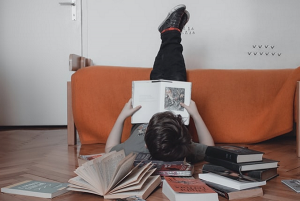
What Picture Books Are Actually Doing
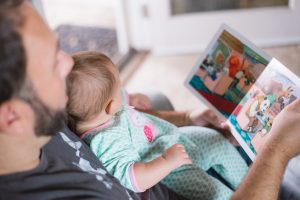
Most people know, in a vague sort of way, that reading to children is good for them. But most people have no idea just how much is happening when an adult sits down with a child and opens a book.
Let’s start with language. Picture books expose children to vocabulary that everyday conversation simply does not. Research from the University of California, Santa Cruz found that picture books are two to three times more likely than parent-child conversations to include words that fall outside the 5,000 most commonly used English words. In other words, reading a picture book to a child introduces them to language that they would rarely, if ever, encounter in daily life. And because the illustrations help clarify the meaning, and they have an adult to help them understand, children can learn these new words, and they tend to remember them.
Beyond vocabulary, picture books are one of the most important foundations for learning to read. Because the words and pictures work together, children are learning how language and stories work, even when it doesn’t look like learning.That foundation makes a huge difference, much more so than most people realise. Long before a child reads on their own, they are building the skills they’ll need.
|
|
|
| Picture books also develop cognitive skills like attention span, memory, problem-solving, and critical thinking. They help children understand things like cause and effect and sequence in a way that transfers into every area of learning.
Emotionally, picture books improve self-awareness, develop empathy, and help children make sense of a world that can sometimes feel confusing or overwhelming. A well-written picture book gives a child the language for feelings they didn’t know how to name, and shows them that they’re not alone in having them.
|
| There’s one more benefit that I think gets overlooked. Because an adult almost always reads a picture book to a child, picture books create moments of connection and closeness, and a wonderful opportunity for conversations you likely would’ve never had otherwise. That’s so important. In a world that’s moving faster all the time, sitting together with a book is one of the simplest and most powerful things a parent or caregiver can do.
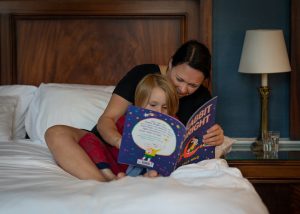
Here’s What the Research Actually Shows
A lot of people think reading is just for fun, or that it doesn’t really make a big difference whether you read with your young child or not. Of course, it should be fun, but it’s so much more than that. There are some incredible facts about readers vs non-readers,
When you look at the research, the picture is remarkable.
A study from the University of Edinburgh tracked people over 35 years and found that reading ability at the age of seven was directly linked to social class, income, and housing in adulthood Going up just one reading level at age seven was associated with roughly $7,750 more in income at age 42. This remained true, even after the researchers accounted for intelligence, education, and childhood socioeconomic background. Pretty incredible, right?!
Children who are not reading at grade level by the end of third grade have a much harder time achieving academic success and graduating on time. Third grade is a turning point: up to this point, kids are learning to read, and after this, they are reading to learn. If they fall behind before third grade, everything that comes after becomes much harder.
Research also shows that, by age three, children who grew up with books being read regularly have heard more than 20 million more words than children from families where they don’t read regularly. That huge gap affects vocabulary, comprehension, and academic readiness in ways that are difficult to make up for later on.
So reading to a child is not just a nice thing to do. It may well be one of the most important investments anyone can make in a child’s future.”
Enjoy whatever you are creating this week,
Pauline
|
|
|
|


Leave A Comment